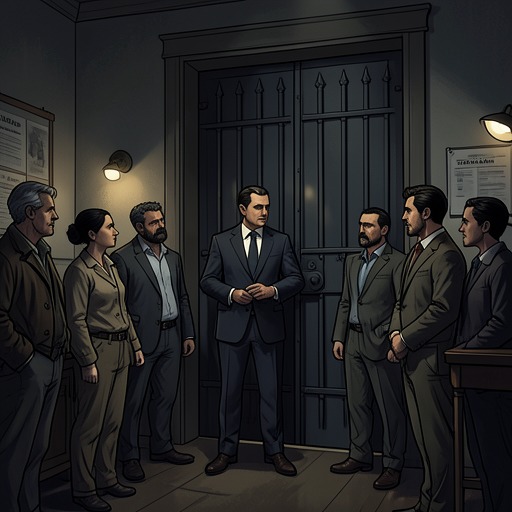
Salvo Montalbano and Pietro Rizzo’s investigative standoff
The Shape of WaterSalvo Montalbano and Pietro Rizzo’s investigative standoff turns a seemingly routine report about a body and a seemingly simple request to return a necklace into a contest over knowledge, discretion, and leverage. Rizzo, a political confidant of Silvio Luparello, initially distances himself from the discovery; later he tries to reclaim an object found by chance and supplies an account designed to explain its loss. Montalbano answers not with an accusation but with carefully staged questions and procedural demands, making the gap between what Rizzo says and what he appears to know the center of their encounter.
The first call: friendship and duty
When Pino and Saro discover Luparello’s body, Pino phones Rizzo because he believes the lawyer was the dead man’s closest friend. Rizzo’s response is strikingly impersonal: he asks why Pino is telling him, then tells the workers to do their duty first. The call ends without the concern or urgency Pino expected. Saro, listening beside him, is equally bewildered by Rizzo’s composure.
For Montalbano, the exchange establishes an early contrast between the public idea of Rizzo as Luparello’s intimate associate and the lawyer’s immediate refusal to treat the discovery as a personal matter. The contrast does not, by itself, explain Rizzo’s motive. It does, however, make his handling of information part of the investigation: the men who found the body were told to contact a friend, and that friend instead sent them back to their official responsibilities.
Political proximity and competing accounts
The stakes of this reserve become clearer against Luparello’s political position. The dead engineer had spent years working behind the scenes, building influence over party figures and public and private contracts before emerging as a champion of renewal. He had become provincial secretary only three days before his death. Rizzo’s political closeness to him places the lawyer near the abrupt transfer of power that follows, even as Rizzo’s response to the discovery presents him as detached from the immediate personal crisis.
When Rizzo later approaches Montalbano about a necklace, he does not initially name the owner. He says he has heard that an object found on the ground was turned over to the inspector and that he has been instructed to reclaim it. Montalbano reacts with amusement: he had used Jacomuzzi as a means of letting the necklace become known, and Rizzo’s approach confirms that the information has reached the person he wanted to test. The exchange sharpens their asymmetry. Rizzo has arrived seeking an object; Montalbano has already made its existence a probe into who is watching the investigation and what they know.
The necklace as a test of discretion
Rizzo then supplies a detailed explanation. According to his account, a respectable young couple went to the Pasture after drinking, the wife got out of the car, was harassed, and quickly returned to it; only after they reached home did she realize that a valuable necklace was missing. Montalbano answers with a remark about the coincidence, prompting Rizzo to acknowledge that he, too, noticed it. The inspector then identifies the object as a gold necklace with a heart set with precious stones. Rizzo confirms the description and asks for its return to its rightful owners, with the same discretion that Montalbano had shown when Luparello’s body was found.
That appeal to discretion reaches back to the first call. Rizzo invokes Montalbano’s handling of the body as precedent for keeping the necklace’s recovery quiet, while the inspector’s questions make clear that he is not treating the two matters as separate. The account about the couple is Rizzo’s explanation, not an independently established reconstruction. Montalbano’s response leaves its plausibility open for examination rather than accepting the story as sufficient simply because it arrives from a politically influential lawyer.
Procedure turned into leverage
Montalbano meets Rizzo’s request on procedural ground. If the owner herself had come forward, he suggests, the matter might have been different; instead, he requires Rizzo’s representative to provide a proper receipt. He also demands a cheque for ten million lire, rounded up as the usual finder’s percentage for valuables or large sums of money. The demand converts an attempt at quiet recovery into a documented transaction, placing the necklace within an ordinary rule that Rizzo cannot easily brush aside without making his own position conspicuous.
Montalbano specifies that the cheque must be made out to Baldassare Montaperto, one of the two street cleaners who discovered Luparello’s body. The choice binds the necklace’s recovery to the people involved in the original discovery and makes the finder’s entitlement explicit. Rizzo absorbs the demand and asks whom to pay; he carefully writes down the name. The scene’s civility is part of its pressure. Neither man needs to declare the exchange a confrontation: the receipt, the cheque, and the named recipient turn Montalbano’s suspicions into practical conditions that Rizzo must either accept or contest.
An unresolved contest over what can be said
The standoff is not a simple opposition between an investigator who knows the truth and a lawyer who openly confesses to concealment. Its force lies in controlled speech. Rizzo first declines the emotional role Pino assigns him, later seeks the necklace through an intermediary, and explains its disappearance through a story that Montalbano tests rather than endorses. Montalbano, in turn, uses humor, pointed questions, and the finder’s rule to make Rizzo’s knowledge visible without prematurely disclosing everything the investigation has established.
Their encounters also place personal discretion beside public power. Rizzo’s request to keep the recovery quiet echoes his instruction that the finders do their duty, but Montalbano insists that duty includes a traceable account of the object and a reward for the person who found it. The resulting relationship is a strategic investigative standoff: Rizzo tries to manage what becomes public, while Montalbano makes procedure expose the connections that discretion would otherwise leave obscured.